Kcal Dog Food Calculator
Work out roughly how many calories your dog needs each day and how much of your dog food that equals. Enter weight, life stage and activity, and the calculator uses veterinary energy formulas to estimate kcal per day, then converts to cups or grams using the calories printed on your food bag.
- Free to use
- No sign-up
- Runs in your browser
Quick answer
Use this kcal calculator for dogs to estimate daily calories from weight, life stage and activity: RER = 70 × kg^0.75, then multiply by the appropriate factor. Enter your food’s kcal per cup or kcal/kg to convert calories into cups or grams per day. For diabetic dogs, use your veterinarian’s calorie target and feeding schedule; consistency matters more than a generic estimate.
Calculate daily calories for your dog
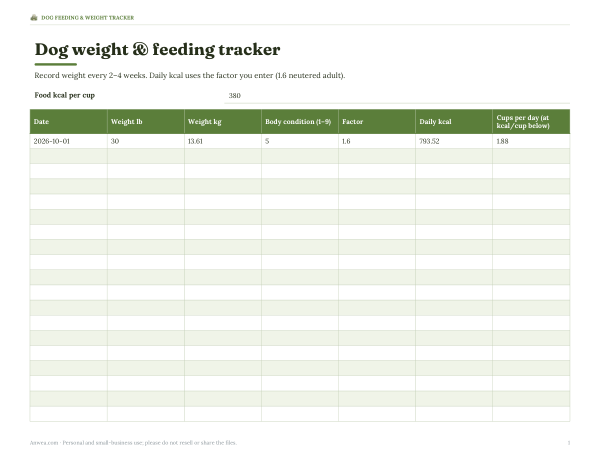
Dog Feeding & Weight Tracker
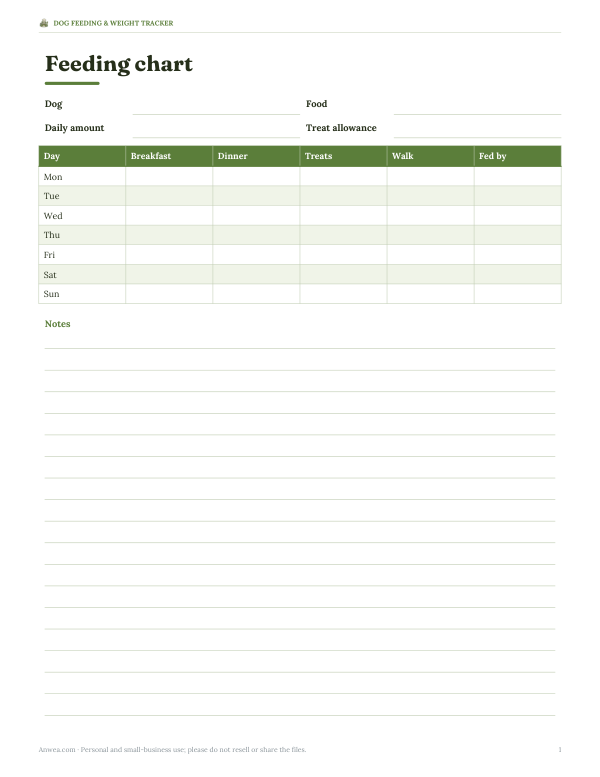
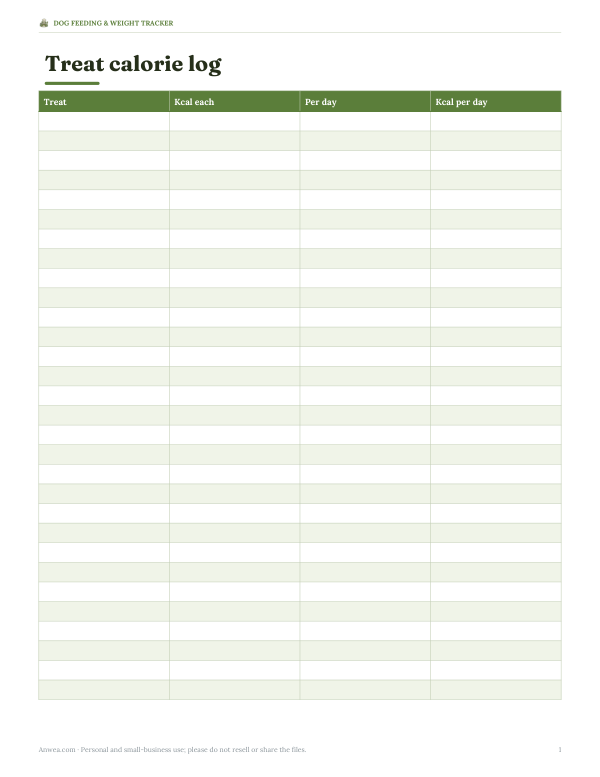
A weight and body-condition tracker with automatic calorie adjustment, a printable feeding chart for the fridge and a treat calorie log.
- Weight & feeding workbook (XLSX, PDF)
- Printable feeding chart (PDF, DOCX)
- Treat calorie log (PDF, XLSX)
Formats: XLSX, PDF, DOCX. Instant download after payment (link valid 72 hours, up to 5 downloads). AI-assisted: the templates were drafted with AI help and reviewed and laid out before publishing.
$3.00 USD, one-time 3 files · about $1.00 each
- Instant download
- 7-day refund
- Secure checkout by Stripe
7-day money-back guarantee. Full refund within 7 days of purchase, even after you download.
Full refund within 7 days — see the refund policy and license.
Free printables
Single sheets you can print right now, no sign-up. The full pack adds every sheet in one download plus the editable files.
Dog kcal factors used by the calculator
These common veterinary starting factors turn RER into estimated daily calories.
| Dog or goal | Daily kcal estimate | Notes |
|---|---|---|
| Neutered adult | 1.6 × RER | Typical pet activity |
| Intact adult | 1.8 × RER | Typical activity |
| Inactive adult | 1.2–1.4 × RER | Overweight-prone |
| Senior, less active | 1.4 × RER | Adjust by condition |
| Weight loss | 1.0 × target-weight RER | Use target weight |
| Active or working | 2–5 × RER | Calculator uses 2.5 |
| Puppy 0–4 months | 3.0 × RER | Growth food needed |
| Puppy 4 months–adult | 2.0 × RER | Until adult size |
How dog calorie needs are estimated
Veterinarians commonly estimate a dog's energy needs in two steps. First, the resting energy requirement (RER) — the calories needed for basic body functions at rest — is calculated from body weight: RER = 70 × (body weight in kg)^0.75. Then RER is multiplied by a factor for life stage and lifestyle to give the maintenance energy requirement (MER), the calories needed per day. A typical neutered adult pet dog is often estimated at about 1.6 × RER; an intact adult at about 1.8 × RER; a dog on a weight-loss plan at about 1.0 × RER calculated for its target weight; and a growing puppy at 2 to 3 × RER.
These factors are widely used starting points in veterinary nutrition. Real dogs vary a lot — two dogs of the same weight can differ by 20 to 30 percent in how much they need — so the result is a starting amount to adjust, not an exact prescription.
Converting calories into food
Dog food labels in the United States state calorie content, usually as kcal per kilogram and kcal per cup (or per can). Divide the daily calories from food by the kcal per cup to get cups per day, or by kcal per kg and multiply by 1,000 for grams. Weighing food on a kitchen scale is more accurate than using a measuring cup, because kibble size and how you scoop change how much fits in a cup.
| Food type | Typical calorie density |
|---|---|
| Dry kibble (maintenance) | About 3,300–4,200 kcal/kg; roughly 300–500 kcal per cup |
| Weight-management dry food | Often lower, around 3,000–3,400 kcal/kg |
| Performance / puppy dry food | Often 4,000–4,500 kcal/kg |
| Wet (canned) food | About 800–1,200 kcal/kg; varies by can size |
Worked example
A 30 lb (13.6 kg) neutered adult dog with typical activity has an RER of 70 × 13.6^0.75 ≈ 494 kcal per day. Multiplying by 1.6 gives an MER of about 790 kcal per day. Allowing 10% for treats leaves about 711 kcal from food. With kibble at 380 kcal per cup, that is about 1.9 cups a day — roughly 0.9 cups at each of two meals. If the food is 3,600 kcal per kg, it is about 198 g per day.
Adjusting with body condition
The best check is your dog's body condition, not the scale alone. On the common 9-point body condition score, an ideal dog (4–5 out of 9) has ribs that are easy to feel with a thin fat covering, a visible waist behind the ribs when viewed from above, and an abdominal tuck from the side. If your dog is gaining weight on the calculated amount, reduce food by about 10% and recheck in two to four weeks; if it is losing weight or seems hungry and thin, increase by about 10%. For weight loss, veterinarians usually calculate calories for the target weight and aim for gradual loss of about 1–2% of body weight per week.
Treats and extras
A common guideline is that treats should make up no more than about 10% of daily calories, so the main diet stays balanced. Chews, training rewards, dental sticks and table scraps all count. A large dental chew can contain 100 calories or more — a sizeable share of a small dog's day. Use small pieces for training, or set aside part of the daily kibble ration as rewards.
Puppies, seniors and special cases
- Puppies need more calories per kilogram and a food formulated for growth; large-breed puppies need controlled calcium and energy to avoid growing too fast.
- Seniors are often less active and may need fewer calories, although some older dogs lose weight and need more.
- Pregnant and nursing dogs have much higher needs — often several times RER during peak lactation — and should be fed under veterinary guidance.
- Working and sporting dogs may need two to five times RER depending on workload and weather.
- Dogs with medical conditions such as kidney disease, diabetes or pancreatitis need diets set by a veterinarian.
Feeding tips
- Split the daily amount into two meals for most adult dogs; puppies often need three or four.
- Measure every meal; free-feeding makes weight gain likely.
- Change foods gradually over about a week to avoid stomach upset.
- Keep fresh water available at all times.
- Weigh your dog every few weeks and record it.
Reading a dog food label
In the US, the calorie statement is usually near the guaranteed analysis and is expressed as metabolisable energy (ME) in kcal per kilogram and per cup or can. The label's own feeding guide gives a range by weight; it is a sensible cross-check, but it is designed to cover many dogs and often errs on the generous side. Look for a nutritional adequacy statement (for example, formulated to meet AAFCO nutrient profiles for adult maintenance or for all life stages) so you know the food is complete and balanced for your dog's life stage.
Frequently asked questions
How does a kcal calculator for dogs work?
It calculates RER from body weight in kilograms, then multiplies by a life-stage or activity factor to estimate daily kcal. The result is a starting point to adjust by body condition and weight trend.
Is there a diabetic dog food calculator?
A diabetic dog’s calories and meal timing should be set with a veterinarian, especially if insulin is used. You can use this calculator only as a rough cross-check against the vet-set feeding plan.
How do I convert dog kcal to cups?
Subtract treat calories, then divide the remaining food calories by the kcal per cup printed on your dog food label. For grams, divide by kcal per kg and multiply by 1,000.
How many calories does a dog need per day?
Very roughly 30 kcal per pound for small dogs down to about 20 kcal per pound for large dogs, but use the calculator: RER × a life-stage factor gives a better estimate.
What is RER for dogs?
Resting energy requirement: 70 × (weight in kg)^0.75 kcal per day.
How many cups of food should my dog eat?
Divide daily calories from food by the kcal per cup on your food bag.
Should I use my dog's current or ideal weight?
For maintenance at a healthy weight, the current weight. For weight loss, vets typically calculate for the target weight.
Do treats count?
Yes. Keep treats to about 10% of daily calories.
Is this a substitute for veterinary advice?
No. It is a starting estimate. Ask your veterinarian, especially for puppies, pregnancy, weight loss or illness.